

Resume
When a pile of grains is submitted to a series of taps, the packing fraction η increases. In physics, this phenomenon is called compaction. The packing fraction evolution is fast during the first taps and slows down to reach an asymptotic value η∞. Some studies made in Chicago, Paris and Rennes show that the compaction dynamic depends on the characteristics of the taps and on the geometry of the pile. Moreover, the range of packing fractions reachable by the pile depends on the grain shapes, on the friction and on the cohesion between the grains.
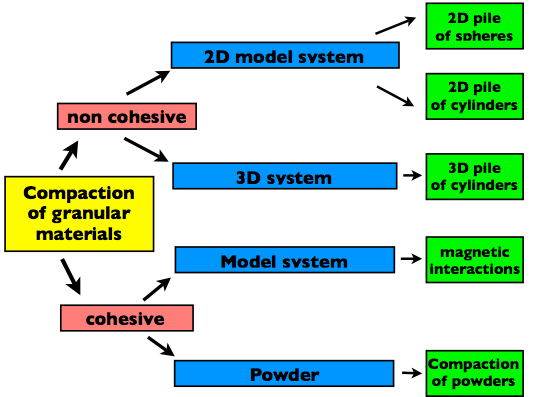
We have started our experimental study of compaction with a model system. This system is a pile of monodisperse spheres confined between two glass plates separated by the diameter of one grain. This configuration allows a measurement of the grain positions between each tap. In this 2D geometry, we have observed that the compaction of the pile is related to the growth of domains of ideally ordered grains. Thus, we have made a model based on a crystalline growth process. This model fits correctly the experimental data.
Afterwards, with the same experimental setup, we have made a study with cylindrical grains in order to study the influence of the grain shape. In the 2D case, we have observed a two stages compaction dynamic. At the beginning of the process, the grains are moving in order to form some domains of aligned grains. Afterwards, these domains are sheared to form some domains of aligned and ordered grains.
In the 3D geometry, we have analysed the influence of the lenght l of elongated grains and the influence of the container diameter D on the packing fraction. It appeared that the important parameter is the ratio l/D. The influence of this parameter on the packing fraction has been quantified.
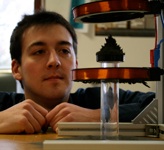
After these studies of non cohesive granular materials, a study of the influence of the cohesion between the grains has been made. Granular materials become cohesive when the size of the grains becomes typically inferior to 50 μm. Indeed, in this case, forces due to humidity, to electrostatic charges or to Van der Waals interactions become in the same order of magnitude than the weight of one grain. The control of the cohesive forces in a powder is difficult. Moreover, the shape of the grains in fine powder is usually complicated. For these reasons, we have developed a model cohesive granular material. This material is made of spherical monodisperse metallic beads. The interaction between the grains is induced by a tunable magnetic field. With this system, we have made a study of the decrease of the packing fraction as a function of the cohesion between the grains. Moreover, we have observed that it's possible to tune the packing fraction. For that, the cohesion between the grains is used during the initialization of the pile.
After the study of this model system, we have developed a device dedicated to powder compaction measurement. The analysis of the compaction curves permits to determine the initial packing fraction η0, the asymptotic packing fraction η∞ and a characteristic time τ. A comparative study has been made with fifty samples of powder. With these powders, we have made measurements with a rotating drum, with a Jenike shear tester and with our compaction device. This study has shown that the characteristic time τ is directly linked to the flowability of the powder.